
Recent Advances in Diabetes Treatment: A Comprehensive Literature Review

Written By: Marah Younis
Edited By: Rachel Lee
Abstract
Diabetes mellitus remains a critical global health challenge requiring long-term, multi-faceted clinical management. In recent years, the treatment of diabetes has changed significantly. While controlling blood glucose remains an important goal, modern diabetes care also considers the protection of other organs, particularly the heart and kidneys. This literature review examines three important modern treatment approaches: GLP-1 receptor agonists, dual GIP/GLP-1 receptor agonism with tirzepatide, and SGLT2 inhibitors. These treatments work through different pathways and may provide benefits beyond blood glucose control, including cardiovascular, kidney, and weight-related benefits. Current treatment guidelines therefore increasingly support a person-centered approach in which medication choices consider an individual’s health conditions, treatment goals, and potential cardiovascular and kidney risks.
1. Introduction
Diabetes mellitus has become a major global health concern, with approximately 830 million people living with diabetes worldwide in 2022 (World Health Organization [WHO], 2024). Diabetes can contribute to serious health problems, including cardiovascular disease and kidney disease, which makes long-term management especially important.
For many years, diabetes treatment focused mainly on lowering blood glucose levels. Although blood glucose control remains essential, the approach to diabetes management has expanded. Modern treatment also considers whether a medication can help protect the heart and kidneys, manage body weight, and address other health conditions that may occur alongside diabetes (American Diabetes Association [ADA], 2026).
This change has been supported by large clinical trials and research into newer medications. Some modern treatments can improve blood glucose while also providing additional cardiovascular or kidney benefits. As a result, treatment decisions are increasingly based not only on blood sugar levels but also on the individual's overall health and medical needs (ADA, 2026).
2. Recent and Emerging Treatments in Pharmacotherapy
The development of newer glucose-lowering medications has expanded the available options for people with type 2 diabetes. These treatments work in different ways: some influence hormones involved in blood glucose regulation, while others act directly on the kidneys.
Among the important modern treatment approaches are GLP-1 receptor agonists, dual GIP/GLP-1 receptor agonists such as tirzepatide, and SGLT2 inhibitors. Each class has a different mechanism of action and may offer different benefits depending on the individual (ADA, 2026).
2.1 GLP-1 Receptor Agonists
GLP-1 receptor agonists are medications that act in a similar way to a naturally occurring hormone called glucagon-like peptide-1 (GLP-1). GLP-1 is involved in the body’s response to food and helps regulate blood glucose.
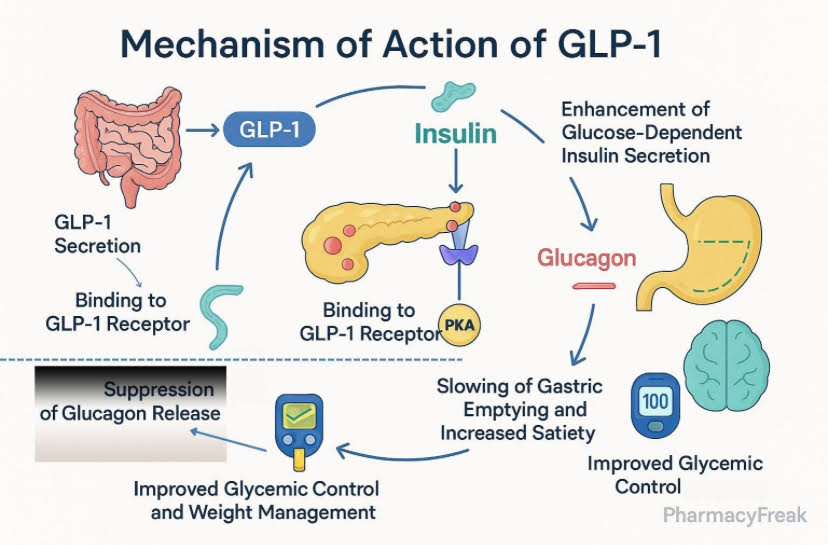
After a person eats, GLP-1 helps the pancreas release insulin when blood glucose levels are elevated. Insulin allows glucose to move from the blood into cells, where it can be used for energy. GLP-1 also reduces the release of glucagon, a hormone that normally raises blood glucose. In addition, GLP-1 can slow gastric emptying, which plays an important role in improving blood glucose levels after meals (Liu, 2024).
These medications can also influence appetite and body weight. Research has increasingly shown that GLP-1 receptor agonists may provide benefits beyond glucose control. A 2025 meta-analysis of randomized clinical trials found that GLP-1 receptor agonists were associated with lower risks of major cardiovascular events and important kidney outcomes in people with type 2 diabetes (Badve et al., 2025).
Therefore, GLP-1 receptor agonists have become an important part of modern diabetes treatment, particularly for people who may benefit from their cardiovascular, kidney, glucose-lowering, or weight-related effects (ADA, 2026).
2.2 Dual GIP/GLP-1 Receptor Agonism: Tirzepatide
Building on GLP-1-based treatments, researchers developed medications that can activate more than one hormone pathway. Tirzepatide is a dual receptor agonist that activates both the glucose-dependent insulinotropic polypeptide (GIP) receptor and the GLP-1 receptor (France & Syed, 2024).
GIP and GLP-1 are both hormones involved in the body’s response to food and blood glucose regulation. By acting on both pathways, tirzepatide can influence glucose control through two complementary mechanisms. This makes it different from medications that activate only the GLP-1 receptor.
Clinical evidence from the SURPASS program showed that once-weekly tirzepatide produced substantial reductions in blood glucose and body weight in adults with type 2 diabetes. In several trials, it provided greater glucose and weight reductions than some commonly used GLP-1 receptor agonists and insulin-based treatments (France & Syed, 2024). Current diabetes guidelines also recognize tirzepatide as a dual GIP/GLP-1 receptor agonist with very high glucose-lowering and weight-loss efficacy (ADA, 2026).

2.3 SGLT2 Inhibitors
SGLT2 inhibitors work differently from GLP-1-based treatments because they act primarily in the kidneys. Normally, the kidneys filter glucose from the blood. A large amount of this glucose is then reabsorbed and returned to the bloodstream. SGLT2 inhibitors block a protein called sodium-glucose cotransporter-2 (SGLT2), which is responsible for much of this glucose reabsorption in the kidney. As a result, more glucose leaves the body through urine, helping to lower blood glucose levels (Seidu et al., 2024).
The benefits of SGLT2 inhibitors extend beyond glucose control. Research has shown that this group of medications can provide cardiovascular and kidney protection and can reduce the risk of hospitalization for heart failure in appropriate patients. Current guidelines recommend SGLT2 inhibitors for certain people with type 2 diabetes who have heart failure or chronic kidney disease, because of these additional benefits (ADA, 2026; Seidu et al., 2024).

3. Comparative Summary of Modern Therapeutic Classes
To better understand the differences between these modern treatments, the following table summarizes their main mechanisms and clinical benefits:
Therapy Class | Primary Mechanism | Key Clinical Benefit |
GLP-1 Receptor Agonists | Act like the natural GLP-1 hormone, increasing insulin release when blood glucose is high, reducing glucagon release, and slowing gastric emptying | Blood glucose control, cardiovascular and kidney benefits, and weight management |
Tirzepatide | Activates both GIP and GLP-1 receptors, combining two hormone pathways involved in glucose regulation | Strong blood glucose control and significant weight reduction |
SGLT2 Inhibitors | Block glucose reabsorption in the kidneys, allowing more glucose to leave the body through urine | Blood glucose control, heart failure risk reduction, and kidney protection |
Although these medications all help manage diabetes, they work in different parts of the body and through different biological mechanisms. GLP-1 receptor agonists primarily influence hormone signaling involved in glucose regulation and appetite, while also providing cardiovascular and kidney benefits. Tirzepatide combines GIP and GLP-1 activity and provides strong glucose-lowering and weight-loss effects. In contrast, SGLT2 inhibitors act directly on glucose reabsorption in the kidneys and offer important cardiovascular and kidney-protective effects. The choice between these treatments depends on individual factors, including cardiovascular and kidney health, weight-related goals, treatment tolerability, and personal preferences (ADA, 2026).
4. Conclusion and Future Directions
The treatment of diabetes has developed considerably, moving beyond a narrow focus on blood glucose control toward a broader approach that considers long-term cardiovascular, kidney, and metabolic health. GLP-1 receptor agonists, tirzepatide, and SGLT2 inhibitors are important examples of this change.
Future research will continue to explore how these treatments can be used most effectively and how treatment choices can be tailored to individual patients. As our understanding of diabetes continues to develop, personalized treatment strategies may help healthcare professionals balance glucose control with the protection of cardiovascular and kidney health.
Sources & References
American Diabetes Association Professional Practice Committee for Diabetes. (2026). Standards of care in diabetes—2026. Diabetes Care, 49(Suppl. 1), S1–S5. https://doi.org/10.2337/dc26-SINT
Badve, S. V. et al. (2025). Effects of GLP-1 receptor agonists on kidney and cardiovascular disease outcomes: A meta-analysis of randomised controlled trials. The Lancet Diabetes & Endocrinology, 13(1), 15–28. https://doi.org/10.1016/S2213-8587(24)00271-7
France, N. L., & Syed, Y. Y. (2024). Tirzepatide: A review in type 2 diabetes. Drugs, 84(2), 227–238. https://doi.org/10.1007/s40265-023-01992-4
HL Benefits. (2026). SGLT2 Inhibitors for Longevity and Anti-Aging. https://hlbenefits.com/sglt2-inhibitors-longevity-anti-aging?utm_source=chatgpt.com
inMedicato. (2026). Mounjaro resultaten: wat kun je verwachten van de behandeling?https://www.inmedicato.com/mounjaro-resultaten?utm_source=chatgpt.com
Liu, Q. K. (2024). Mechanisms of action and therapeutic applications of GLP-1 and dual GIP/GLP-1 receptor agonists. Frontiers in Edocrinology,15, 1431292. https://doi.org/10.3389/fendo.2024.1431292
Pharmacy Freak Editorial Team. (2025, July 11). Mechanism of action of GLP-1.PharmacyFreak https://pharmacyfreak.com/mechanism-of-action-of-glp-1-receptor-agonists/?utm_source=chatgpt.com
Seidu, S. et al. (2024). SGLT2 inhibitors—The new standard of care for cardiovascular, renal and metabolic protection in type 2 diabetes: A narrative review. Diabetes Therapy, 15(5), 1099–1124. https://doi.org/10.1007/s13300-024-01550-5
World Health Organization. (2024, November 14). Diabetes. World Health Organization. https://www.who.int/news-room/fact-sheets/detail/diabetes


Comments