
Photosynthesis Phase II: Dark Reactions

Updated: Aug 9
Written By: Eeshaal Hassan Khan
Edited By: Rachel Lee

Introduction:
Did you know that plants make food using the carbon dioxide you breathe out? If you are familiar with the Light Reactions of photosynthesis (learn more in our article here!), you might be wondering what happens to the energy from the sun once captured during the light reactions, and how exactly ATP and NADPH (the plant’s rechargeable batteries) are used in sugar synthesis.
The answers lie in a fascinating process called the Dark Reactions, also known as the Calvin cycle. While the first stage of photosynthesis—the light reactions—occurs in the thylakoids (coin-like structures in chloroplasts that capture energy like solar panels), the dark reactions take place in the stroma, the jelly-like fluid surrounding the thylakoids. The stroma functions like the plant’s kitchen, where energy from the light reactions is combined with carbon dioxide to produce sugars.

Let’s follow this remarkable journey to discover how plants produce the sugars they need to survive—and how this process creates the food that sustains nearly all life on Earth.
An Overview of Dark Reactions: The Sugar-Making Stage of Photosynthesis
The dark reactions, also known as the Calvin cycle, form the second stage of photosynthesis. Unlike the light reactions, they do not require sunlight directly. Instead, they use the energy-rich molecules ATP and NADPH, produced during the light reactions, to drive the synthesis of sugars. For this reason, they are also called light-independent reactions.
The primary goal of the Calvin cycle is to capture carbon dioxide from the atmosphere and convert it into energy-packed sugars such as glucose, which plants use for growth, storage, and survival. These sugars also supply energy to humans and animals and are therefore critical for our survival.
The Calvin cycle proceeds through three sequential stages described below: 1) carbon fixation, 2) reduction, and 3) RuBP regeneration.
Step I: Carbon Fixation
The journey begins when carbon dioxide enters the leaf through tiny openings called stomata. It diffuses into the stroma of the chloroplast, where an enzyme called RuBisCO (Ribulose-1,5-bisphosphate Carboxylase) waits to greet it. RuBisCO helps attach a carbon dioxide molecule to a five-carbon sugar with a phosphate group at each end, called RuBP (Ribulose-1,5-bisphosphate).
However, the resulting 6-carbon molecule is highly unstable. Hence, it immediately splits to create two smaller molecules of 3-PGA (3-Phosphoglyceric Acid), each containing three carbon atoms. The plant has now successfully captured and transformed inorganic carbon dioxide into an organic compound made of carbon and hydrogen atoms. Since carbon dioxide has been “fixed” or incorporated into an organic molecule, this step gets the name of carbon fixation.

Thus, for every molecule of carbon dioxide fixed, two molecules of 3-PGA are produced.
Step II: Reduction of Fixed Carbon (Gaining Electrons)
Although stable, the 3-PGA molecules do not contain much energy and must now be converted into a higher-energy compound. This is where ATP and NADPH play their roles. ATP acts like a battery that provides energy, while NADPH supplies high-energy electrons and hydrogen.
First, two ATP molecules react with the two 3-PGA molecules. Each ATP (adenosine triphosphate) molecule removes a phosphate group from itself, converting into ADP (adenosine diphosphate). Their phosphates are transferred to the 3-PGA molecules to energize them, turning them into 1,3-BPG (1-3 Biphosphoglycerate) .
Next, NADPH transfers one hydrogen atom and two electrons to 1,3-BPG, converting into NADP+. By gaining electrons in a process called reduction, 1,3-BPG is converted to the 3-carbon compound G3P (Glyceraldehyde 3-phosphate). During this reduction process, each 1,3-BPG molecule also releases one phosphate group, while ADP and NADP+ return to the light reactions to be re-energised and reused for photosynthesis.
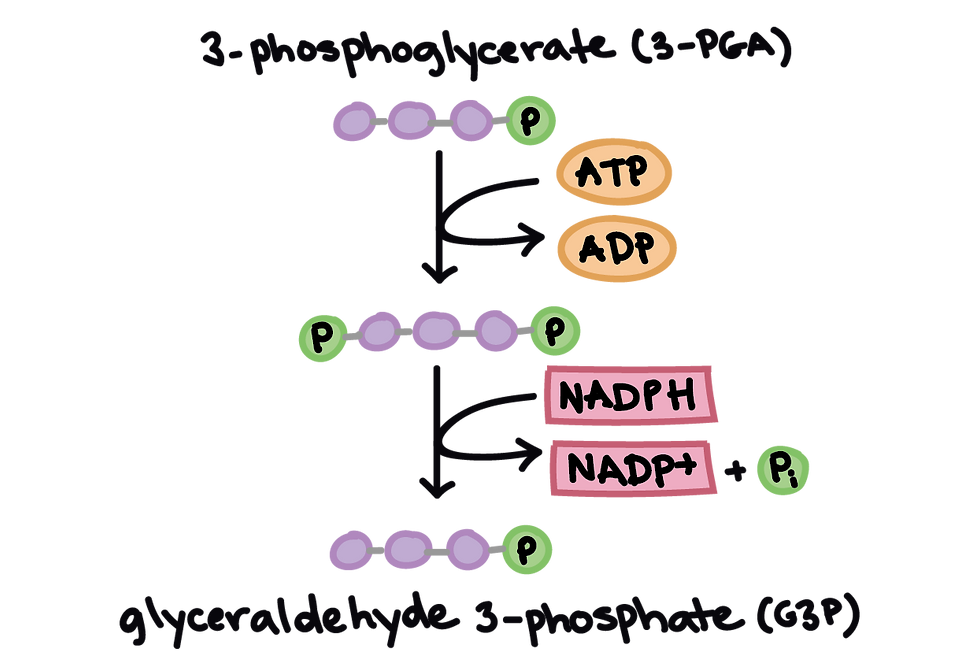
For every three molecules of carbon dioxide fixed, six molecules of 3-PGA are produced, ultimately producing six molecules of G3P. One of these six G3P molecules leaves the cycle to serve as the building block for glucose and other carbohydrates. Two G3P molecules are needed to form a single glucose molecule; therefore, six carbon dioxide molecules are required to produce one glucose molecule. Meanwhile, the remaining G3P molecules participate in Step III—the regeneration of RuBP—allowing the Calvin cycle to continue.
Step III: Regeneration of RuBP
The Calvin cycle cannot continue unless its carbon dioxide acceptor from Step I, RuBP, is regenerated. The five G3P molecules from Step II undergo a series of enzyme-catalysed reactions to form three Ru5P (ribulose-5-phosphate) molecules, a five-carbon compound. ATP then transfers a phosphate group to Ru5P, forming RuBP (Ribulose-1,5-bisphosphate) once again. With RuBP regenerated, the cycle is ready to capture another molecule of carbon dioxide, allowing sugar production to continue.

Final Products of the Calvin Cycle
At each turn of the Calvin Cycle, one carbon dioxide molecule is fixed. For the fixation of one molecule of carbon dioxide, the Calvin cycle consumes 3 ATP molecules and 2 NADPH molecules.
Every three rotations of the Calvin Cycle (three carbon dioxide molecules) produce six molecules of 3-PGA during Step I, the carbon fixation stage.
During Step II, the reduction stage, these six molecules of 3-PGA are converted into six molecules of G3P using ATP and NADPH. Only one of these six G3P molecules is used to synthesize glucose.
Two net G3P molecules are used to form one glucose molecule. Therefore, producing one glucose molecule requires six turns of the Calvin cycle (fixing six molecules of carbon dioxide and producing 12 molecules 3-PGA and G3P). Consequently, the synthesis of one glucose molecule involves the consumption of 18 ATP and 12 NADPH.
During Step III, the regeneration stage, the G3P molecules that were not used to form glucose are phosphorylated to form RuBP, the carbon dioxide acceptor in Step I. This allows the Calvin cycle to continue running and producing sugars.
The overall process can be summarised in the diagram below.

Conclusion:
In essence, the Calvin cycle is a beautifully coordinated sequence of events in which atmospheric carbon dioxide is first captured, then transformed into energy-rich sugar molecules using ATP and NADPH from the light reactions, while simultaneously regenerating RuBP so the cycle can begin again. Through this continuous process, plants convert the Sun’s energy captured in ATP and NADPH into stable chemical energy stored in sugars, providing the foundation for plant growth and supporting nearly every food chain on Earth. Every crisp apple, bowl of rice, and leafy salad starts here, making this tiny cycle a big reason we have nutritious food to eat and the energy to live healthy lives.
But the story doesn’t end there. As plants lock carbon into organic molecules, they also help regulate Earth’s carbon cycle, making the Calvin cycle an essential ally in maintaining our planet’s climate. Every time you enjoy a meal, take a breath in a forest, or admire a field of green, you’re witnessing the incredible impact of this microscopic sugar-making factory working tirelessly inside billions of plant cells. Quietly, continuously, and without ever taking a break, the Calvin cycle helps sustain life on our planet.
Works Cited & References:
Boundless. (2017, May 9). 5.12C: The Calvin Cycle. Biology LibreTexts.
Campbell, N. A., & Reece, J. B. (2005). Biology (7th ed.). Pearson, Benjamin Cummings.
HandWiki. (2023, March 12). Biology:Light-independent reactions - HandWiki. HandWiki. https://handwiki.org/wiki/biology:light-independent_reactions
Khan Academy. (2018). The Calvin Cycle. Khan Academy.
Khan, E.H., & Lee, R. (2026, January 6). Photosynthesis Phase I: Light Reactions. Med-ucate, www.med-ucate.org/post/photosynthesis-phase-i-light-reactions.
Masojídek, J., Ranglová, K., Lakatos, G. E., Silva Benavides, A. M., & Torzillo, G. (2021). Variables Governing Photosynthesis and Growth in Microalgae Mass Cultures. Processes, 9(5), 820. https://doi.org/10.3390/pr9050820
Taylor, M. R., & Campbell, N. A. (1990). Student study guide for Campbell’s biology second edition. Benjamin/Cummings.
Wikipedia Contributors. (2020, January 2). Calvin cycle. Wikipedia; Wikimedia Foundation. https://en.wikipedia.org/wiki/Calvin_cycle


Comments